
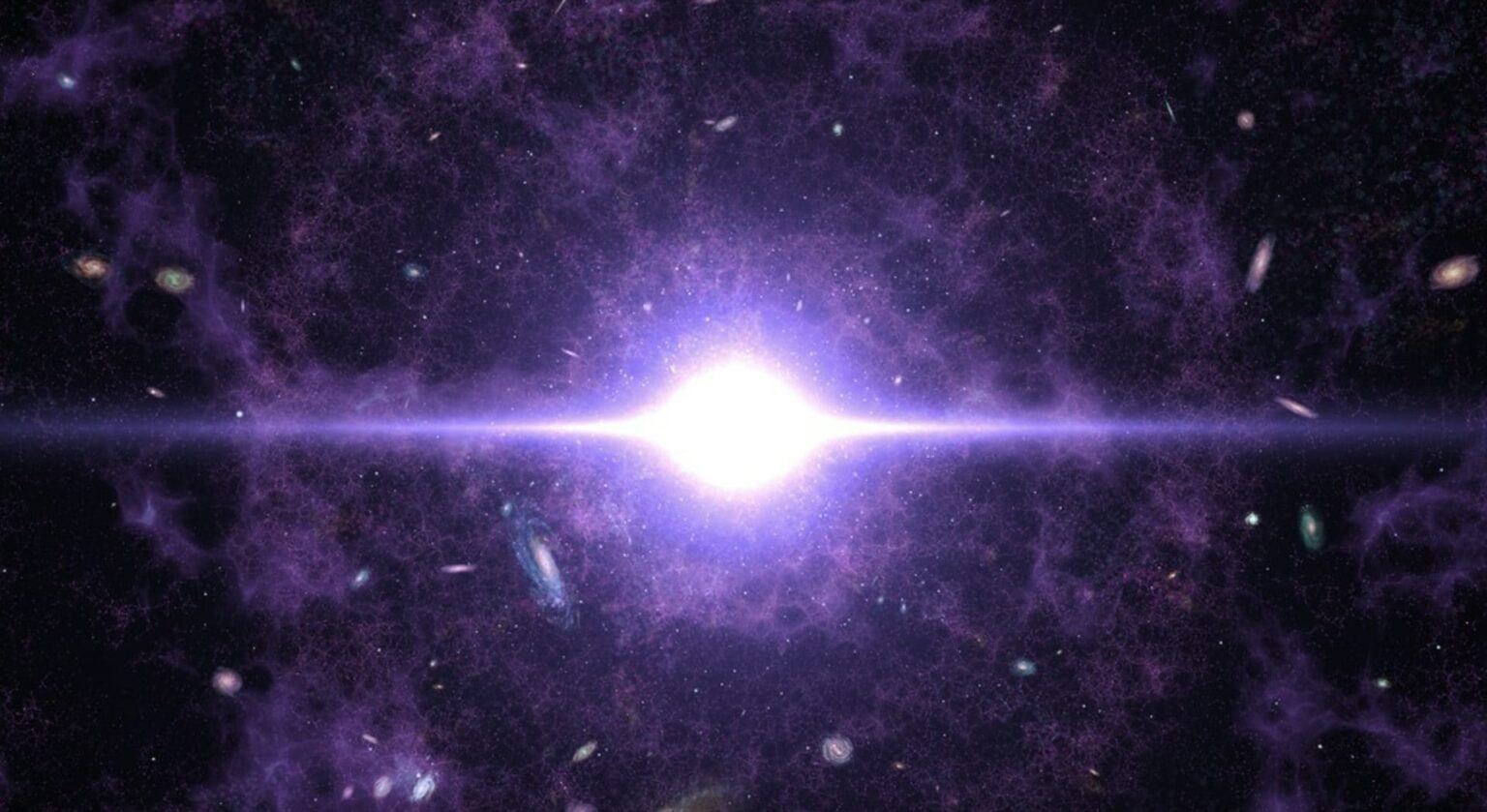
 Credit: NASA’s Goddard Space Flight Center/CI Lab
Imagine a universe that barely exists—just fractions of a second old, too young to look anything like the cosmos we know today. Now, picture black holes, boson stars, and even something as outlandish as “cannibal stars” forming in that moment. It sounds like it doesn’t make any sense, but new research suggests it might have actually happened in the first instances after the Big Bang.
According to physicists in Italy, these cosmic objects were born not from the fusion of atoms, but from bizarre particle interactions that would seem impossible under normal conditions. The new study, published in Physical Review D, shows that during the earliest moments of the universe, a mysterious phase of rapid matter domination may have set the stage for these extraordinary objects to form.
These findings stretch the boundaries of what we thought possible in the chaotic aftermath of the Big Bang. Rather than a cold, empty universe waiting for stars to form, it seems the very first cosmic giants were already taking shape, perhaps even before the first atoms had fully formed.
A Different Take on the Early Universe
We tend to think of the Big Bang as a singular moment in time, but the moments that followed are just as crucial to understanding how the universe took shape. Immediately after the Big Bang, the universe underwent a period of rapid expansion known as inflation. This set the stage for the formation of matter.
 Timeline of the expansion of the universe, where space is represented schematically at each time by circular sections. On the left, the dramatic expansion of inflation; at the center, the expansion accelerates (artist’s concept; neither time nor size are to scale). Credit: Wikimedia Commons.
However, a gap in our knowledge exists between this explosive growth and the formation of the first atomic nuclei—what scientists call the primordial nucleosynthesis phase. The early universe during this time is largely uncharted territory.
But now, researchers are shedding light on this blank space in the cosmic timeline. Their study suggests that, in the moments after inflation, the universe might have experienced a brief Early Matter-Dominated Era (EMDE), a phase where matter, rather than radiation, dominated the cosmos.
This phase could have provided the perfect conditions for the formation of dense “halos” of matter, which then collapsed under gravity to form the first compact cosmic structures: black holes, boson stars, and cannibal stars.
Cannibal Stars: The First Cosmic Predators?
Among these strange early cosmic structures, the “cannibal stars” are perhaps the most intriguing. These stars have almost nothing to do with the ones we know today. They’re powered not by nuclear fusion but by a process known as particle self-annihilation. In this scenario, particles and their corresponding antiparticles within the star annihilate one another, releasing energy in the form of radiation that powers the star, much like the energy generated in a nuclear reaction. The idea of cannibal stars seems like a figment of a researcher’s imagination, but it holds up under the models the researchers have developed.
These stars are distinct from the boson stars, another bizarre early object suggested by the study. Boson stars form when the quantum nature of particles, such as bosons, helps to counterbalance the effects of gravity. The research proposes that both boson stars and cannibal stars could have formed in the aftermath of the gravothermal collapse of early matter halos. However, in certain cases, these structures may not have lasted long before collapsing into primordial black holes.
Speaking of which, the formation of primordial black holes (PBHs) is another key finding of this research. The formation of black holes is often associated with the collapse of large-scale structures much later in the universe’s history. However, this study suggests that black holes might have appeared much earlier—possibly within seconds after the Big Bang.
The research found that the gravitational collapse of matter halos could have produced PBHs with masses smaller than what we typically associate with black holes. These could be tiny, asteroid-sized objects.
The study’s authors also highlight the potential of these early black holes to account for dark matter, an invisible, yet extremely abundant substance that makes up about 85% of the mass in the universe today. The key link to dark matter lies in the non-interacting nature of PBHs: much like dark matter, they wouldn’t emit detectable radiation, making them invisible yet detectable only by their gravitational influence. These PBHs could account for the observed mass of dark matter by exerting gravitational effects on surrounding matter without interacting in other ways, fitting the profile of dark matter perfectly.
New Directions for Modern Research
The researchers suggest that the process of gravo-thermal collapse could also help us understand phenomena occurring in today’s universe. For example, the study proposes that self-interacting dark matter halos could still give rise to structures similar to cannibal stars and boson stars. Understanding how these exotic objects form could open new avenues for research into the composition of dark matter and the early stages of star formation.
While their study deals with some speculative aspects of early cosmic history, it offers a rich framework for exploring how particle physics and gravity might work together in the formation of exotic cosmic objects.
In conclusion, the study suggests that the first moments after the Big Bang were not just a chaotic expansion but a time of rich, complex physical phenomena.