
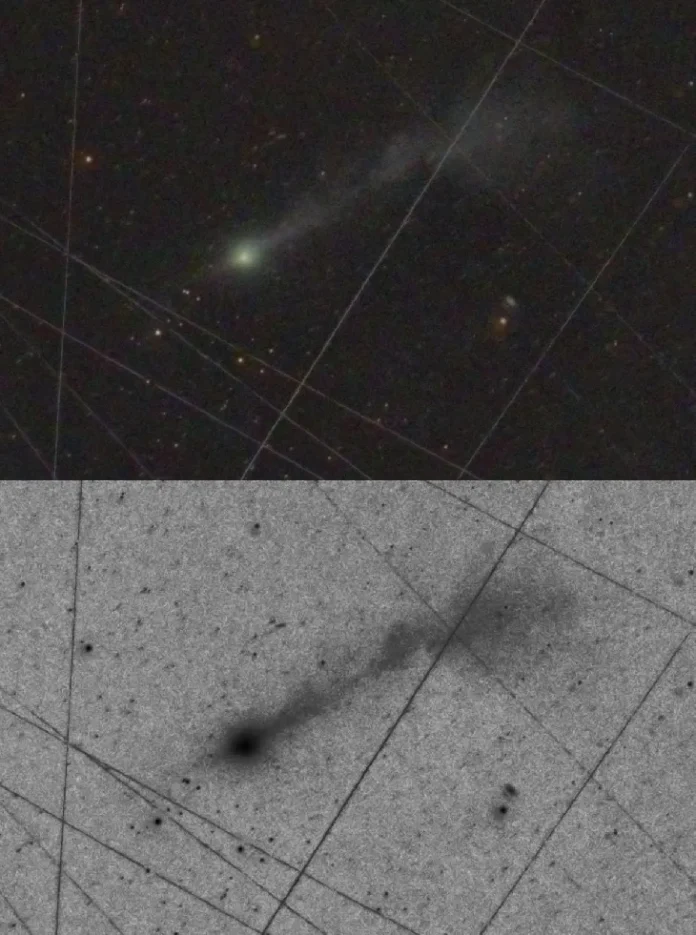
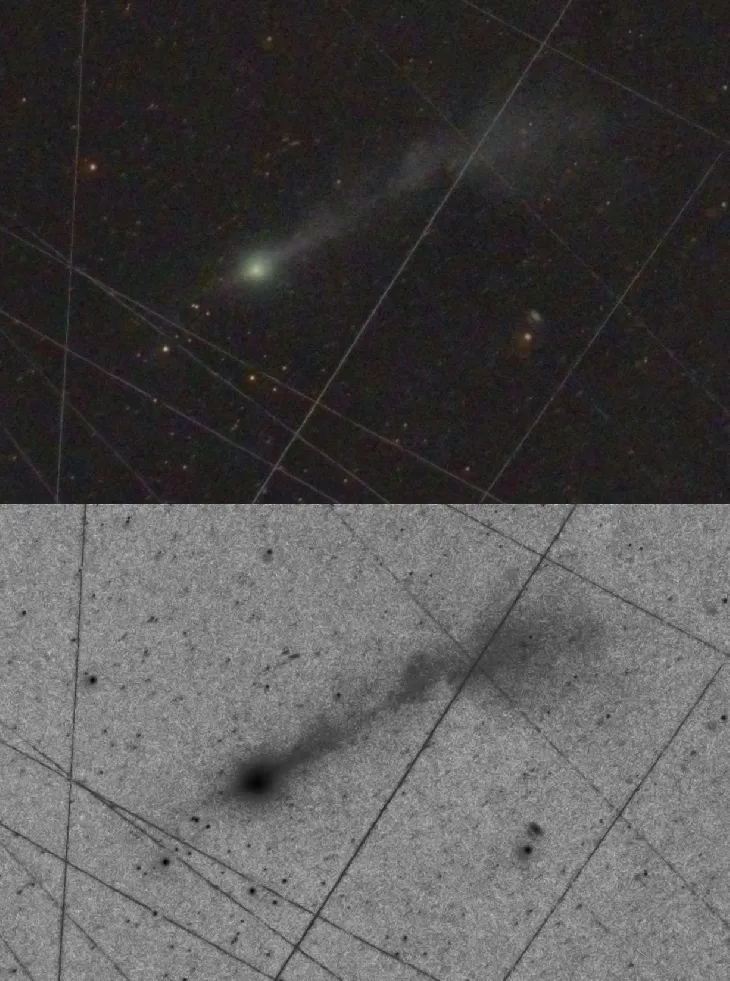
 A composite deep-space image of 3I/ATLAS, captured between 5:08 and 5:22 UT on November 9, 2025, combines five three-minute exposures taken with two telescopes. The Sun lies toward the lower-left corner of the frame. (Image credit: Frank Niebling and Michael Buechner)
By Samuel A. Lopez | USA Herald
In what may become one of the most closely watched astronomical events of the century, scientists are now debating whether the interstellar object 3I/ATLAS — the third known visitor from beyond our solar system — is in the process of breaking apart. The object’s dramatic brightening and mass loss near the Sun, or perihelion, may signal that it has already fragmented into multiple pieces, creating a natural laboratory for studying interstellar materials — and raising new questions about what might happen when those fragments pass near Earth on December 19, 2025.
According to Harvard astrophysicist Avi Loeb, who has led some of the most rigorous analyses of 3I/ATLAS, the sharp increase in brightness observed at perihelion suggests that the object’s surface area expanded significantly — possibly by a factor of sixteen or more. “That kind of increase,” Loeb explains, “would only be possible if 3I/ATLAS broke into multiple fragments, perhaps sixteen or more, each smaller but collectively more reflective than the parent body.”
Previous articleHarnessing Interstellar Objects Like 3I/ATLAS Could One Day Let Humanity Send Messages Beyond the Solar System 
With over 20 years of experience in the legal and insurance sectors, Samuel applies his profound legal acumen to investigate and accurately report on the facts.