
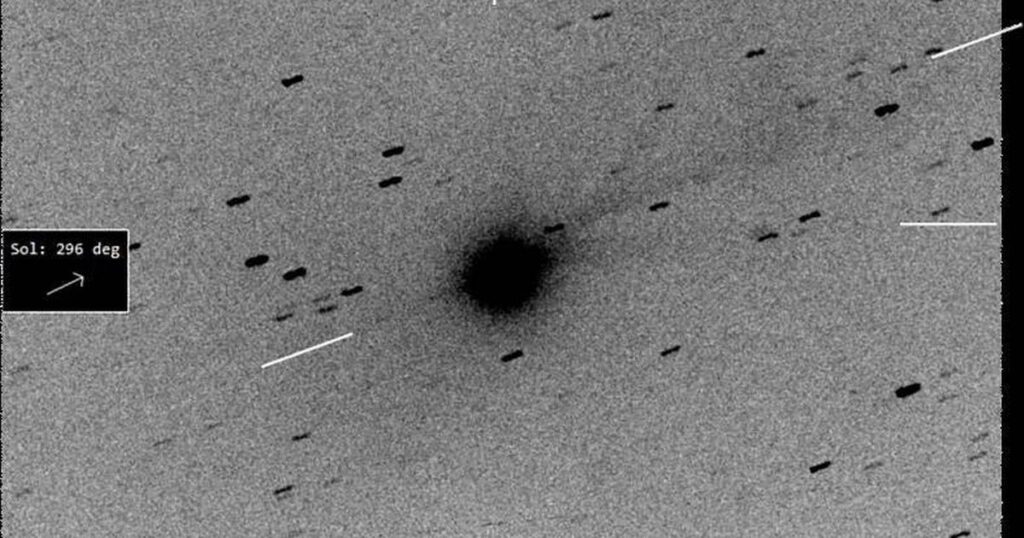
New images have been captured of the mystery object, 3I/ATLAS, as it speeds away from the sun – and for the first time, it shows a “complex tail” structure
Ashley Pemberton News Reporter and Myriam Toua
09:59 ET, 11 Nov 2025
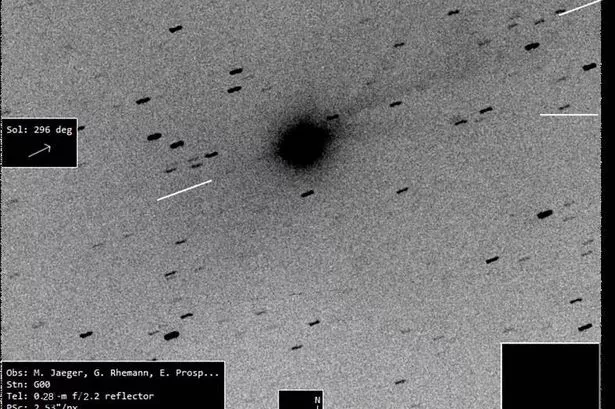 A mysterious object suspected to be an alien spacecraft approaching Earth has revealed an “anti-tail” for the first time as it races away from the sun(Image: M. Jäger, G. Rhemann, E. Prosperi)
A mysterious object suspected to be an alien spacecraft approaching Earth has revealed an “anti-tail” for the first time as it races away from the sun. Fresh images show the “interstellar anomaly” designated as 3I/ATLAS as it rockets through the solar system with a “complex tail” after moving behind the sun last week.
Austrian amateur astronomer Michael Jaeger, who has been monitoring 3I/ATLAS since last Tuesday, photographed a burst of four or five plumes. He informed SpaceWeather.com: “We have something unusual to report. 3I/ATLAS showed a complex tail structure early this morning.”
He observed that during the exposure, the comet was merely seven to 10 degrees above the horizon, but verified that the comet continues on its predicted path.
READ MORE: Alien comet soars through our galaxy and stuns in new Hubble photoREAD MORE: Experts say aliens could be intercepting our radio signals sent into space
Most experts believe it’s a comet that has been journeying for billions of years, but theoretical physicist Avi Loeb has previously cautioned it could be an “extraterrestrial artefact” preparing to make first contact.
 Most experts believe it’s a comet that’s been journeying through the skies for billions of years(Image: NASA)
He informed NBC News: “We see more than seven jets coming out of this object. Of course there are two possibilities that we have considered all along.”, reports the Daily Star.
“That these jets are naturally produced out of ice on the surface of the rock. The second possibility is that they might be thrusters on a technological space craft. So how do we tell the difference?
“Well if it’s a natural object then we know the temperature on the surface of the rock, given its distance from the sun and that gives the characteristic speed of any volatiles that get sublimated and ejected from those pockets of ice.
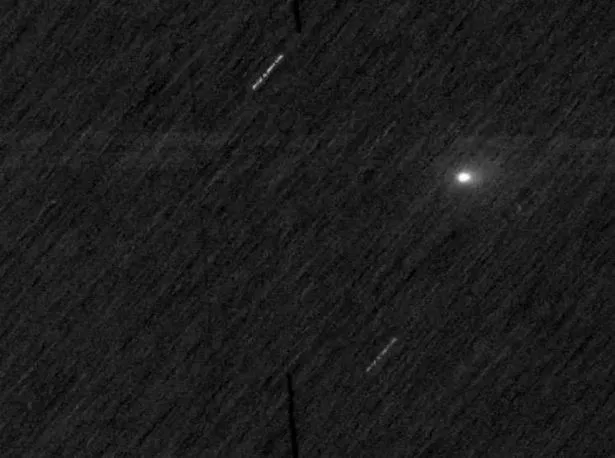 Interstellar comet 3I/ATLAS is hurtling through space(Image: NASA)
“So knowing the speed, we can see how far these jets go into the solar wind. We know the properties of the solar wind and these jets appear to be in the direction of the sun and they go a million kilometers away from the object.
“So knowing the properties, the speed and the density of the solar wind, we can infer how much mass is being carried by these jets. I did some calculations and I found of the order of five billion tons of material.
“Now we ask how much energy is needed to sublimate ice with such a large mass and the answer is – if its carbon dioxide – it needs a surface area of an object that is 20km in diameter, much bigger than we estimated for the actual 3/atlas from the Hubble image captured back in July.”
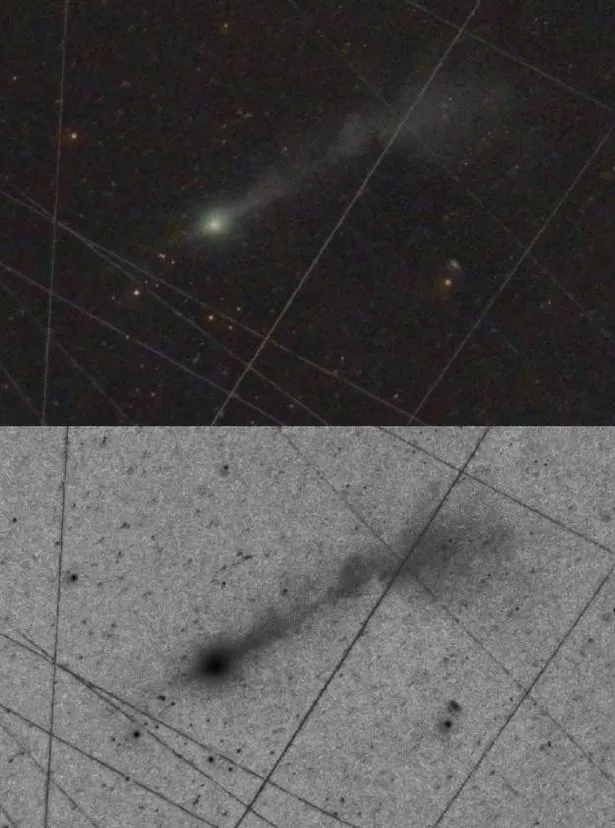 A stacked deep image of 3I/ATLAS, taken between 5:08–5:22 UT on November 9, 2025(Image: britastro)
He suggested that if it was a natural comet, it may have broken up into hundreds of pieces, but we do not yet have a clear enough image to confirm this.
He added: “However, if it is a technological object and we’re talking about technological thrusters, those usually eject gas at a much higher speed.
“Rockets eject gas at 10 times faster than expected from volatiles from the surface of a comet.
“And Iron thrusters go up to 100 times the speed of those natural pockets of ice.
“So we would expect much less mass to be carried on these jets at much higher speed.
 Some scientists have suggested that if it was a natural comet, it may have broken up into hundreds of pieces(Image: AP)
For all the latest news straight to your inbox, sign up for our FREE newsletters here.
“The coming weeks will tell us the answer because if this object is broken up, we will see the pieces and we will see slow moving jets with a lot of mass in them.
“On the other hand, if it’s a tech object, we will see very fast jets with much less material in them and the object maintains its integrity as it moves along.”
First spotted on July 1, 2025, Comet 3I/ATLAS is the third identified object from outside our solar system seen zooming through space.
For the latest local news and features on Irish America, visit our homepage here.