
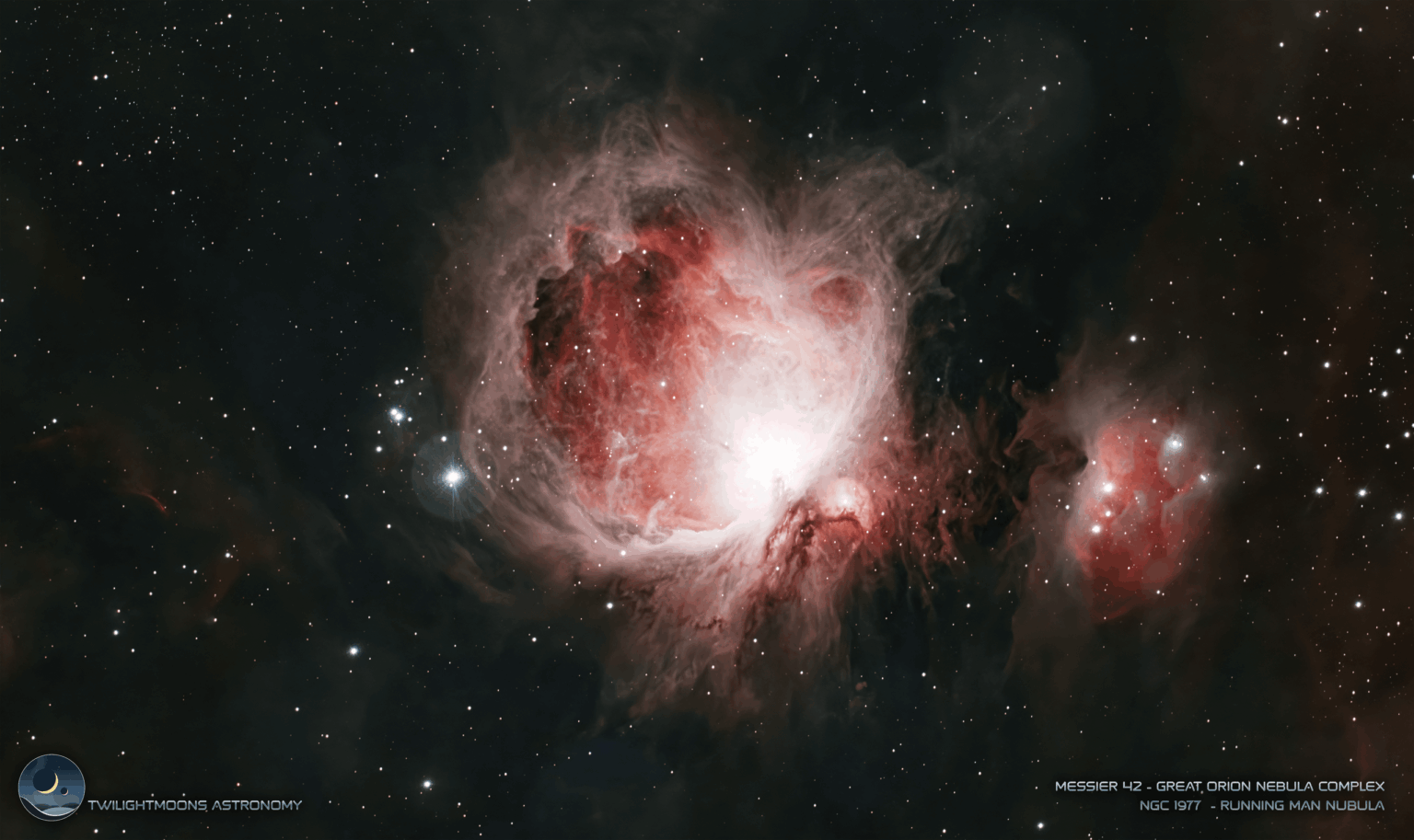

At only 1,500 light-years away, the Messier 42, or the Great Orion Nebula, is the closest large star-forming region to Earth, with relatively bright apparent magnitude of 4. Its prominent location just below Orion’s belt coupled with its brightness allow M42 to easily be spotted with the naked eye, while those with even small telescopes can easily make out the central Trapezium of stars at the core, which light up the rest of the nebula.
Nearby and separated from Messier 42 by dust lane is NGC 1977, the Running Man Nebula. The entire nebula is thought to be illuminated and excited by 42 Orionis, a hot young stellar object, classified as BV1, located within the nebula. It is in fact a triple star system, with the largest star having mass of about 12 sols.
This bright complex is part of the much larger Orion Cloud Complex, and includes gas and dust clouds extending far past the constellation for which it is named.
Integration per filter: – Multiband: 1h 52m (56 × 120"), Bortle 8 skies
Equipment:
– Telescope: Celestron EdgeHD 11"
– Camera: ZWO ASI2600MC Pro
– Mount: iOptron CEM60EC
– Filter: Antlia ALP-T Dual Band 5nm Highspeed 2"
– Accessory: Starizona HyperStar 11 v4 (HS4-C11)
– Software: Adobe Photoshop, Aries Productions Astro Pixel Processor (APP)
For more information, visit AstroBin: https://app.astrobin.com/i/2axhti
by twilightmoons