
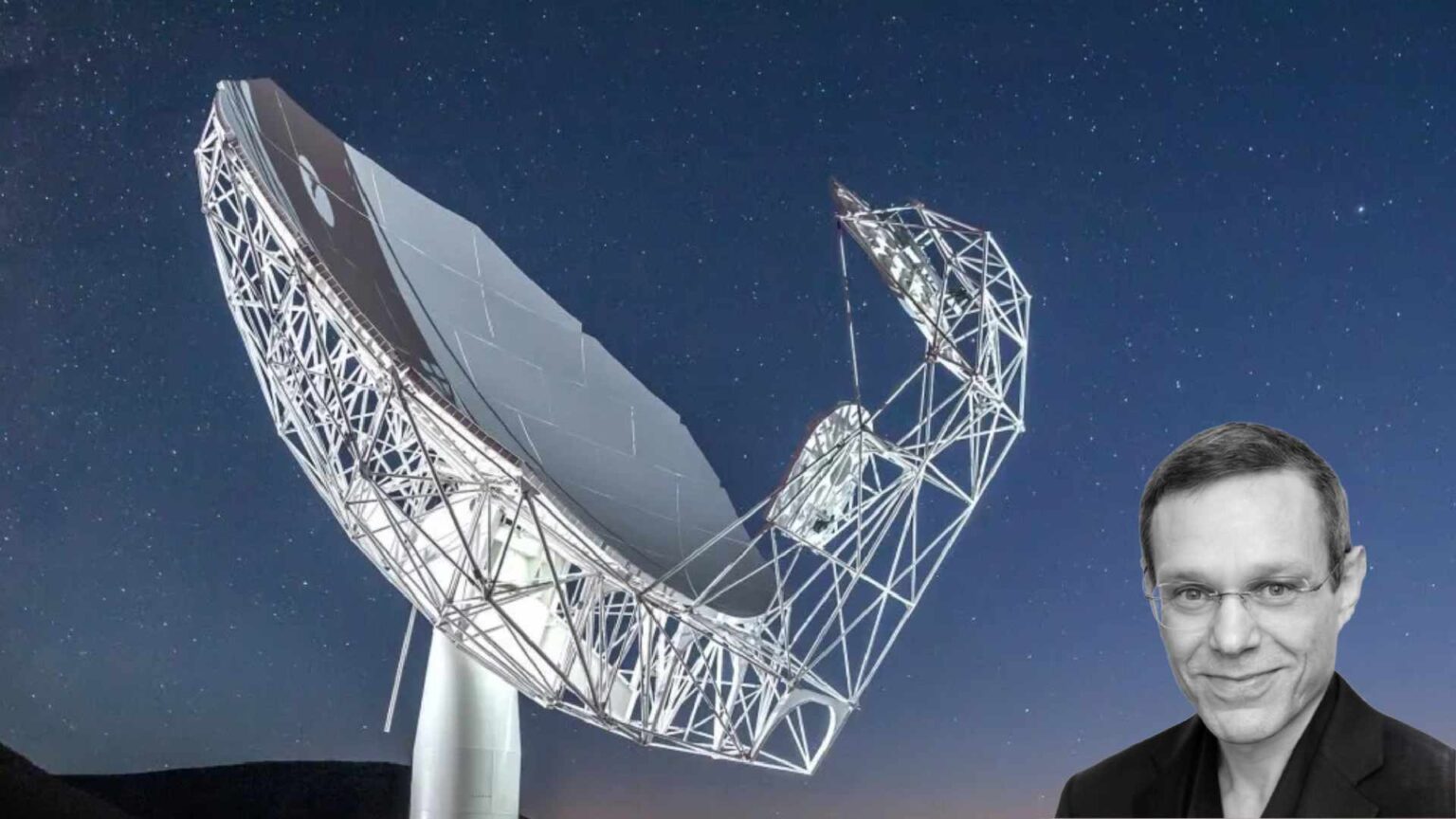
A few days before its perihelion, the interstellar comet 3I/ATLAS emanated radio signals, captured by South Africa’s MeerKAT radio telescope on October 24, 2025. What exactly was the radio whisper by the third-ever interstellar object recorded within a decade since the first (1I/Oumuamua) and the second (2I/Borisov)?
But before we interpret the signal, here’s even more bizarre trivia about the object, which has confounded experts with its quirky behavior, atypical of a comet. As pointed out by Harvard astrophysicist Prof. Avi Loeb, the trajectory of 3I/ATLAS is within 9 degrees of the 1977 Wow! signal’s direction.
For the unversed, the strong narrow band of the radio signal detected on August 15, 1977, by the Big Ear Radio Telescope of the Ohio State University in the US was discovered by astronomer Jerry R. Ehman. The signal lasted for 72 seconds, as Ehman, a SETI volunteer, analyzed in an IBM 1130 machine a huge chunk of data collected between 1965 and 1971 in the Ohio Sky Survey. The incoherent signal may have arrived from somewhere in the constellation Sagittarius.
Here’s what MeerKAT detected on 3I/ATLAS, as reported by D.J. Pisano et al.
We observed 3I/ATLAS with MeerKAT on 24 October 2025 from UTC 05:17:16 to 08:29:37, using the L-band receivers and the NE54M (1.633 kHz channel width) correlator mode, reaching an rms sensitivity of 1.5 mJy/beam in a 0.3 km/s channel with a beam size of 40″. Angular separation from the Sun at the time of observation was 3.76 degrees. OH absorption was detected in both the 1665 MHz and 1667 MHz lines. Gaussian fits to the two lines yielded peak fluxes of -8.4+/-3.1 mJy and -14.2+/-3.4 mJy at -15.59+/-0.16 km/s and -15.65+/-0.17 km/s for the two lines, respectively. The FWHMs were 0.88+/-0.37 km/s and 1.26+/-0.40 km/s. The integrated fluxes over the two lines are -7.9+/-2.9 mJy km/s and -19.1+/-5.2 mJy km/s. The absorption features are consistent with the expected OH level population due to the heliocentric velocity of the comet. The detection of OH on 24 October 2025 contrasts with the MeerKAT non-detection of these lines on 20 September 2025 from 14:36:54 to 15:39:25 UTC (rms noise of 3 mJy/beam) and 28 September 2025 from 10:00:26 to 16:55:53 UTC (rms noise of 1 mJy/beam).
Prof Avi Loeb, broke down the information in his blog
This absorption signal constitutes the first radio detection of 3I/ATLAS.
Given that 3I/ATLAS was separated from the Sun by 1.38 times the Earth-Sun separation, its surface temperature was smaller than that of Earth by roughly the square root of 1.38. This is because the solar heating rate scales inversely with separation squared, whereas surface cooling scales as temperature to the 4th power.
The resulting thermal speed of the OH molecules shed from the surface of 3I/ATLAS at a temperature of ~230 degrees Kelvin yields thermal broadening of the OH lines by a full-width at half maximum of ~0.8 kilometers per second—in agreement with the observed widths.
So it’s just a fingerprint of water molecules breaking down on the comet. Basic comet chemistry. No whisper by an extraterrestrial intelligence, folks.