
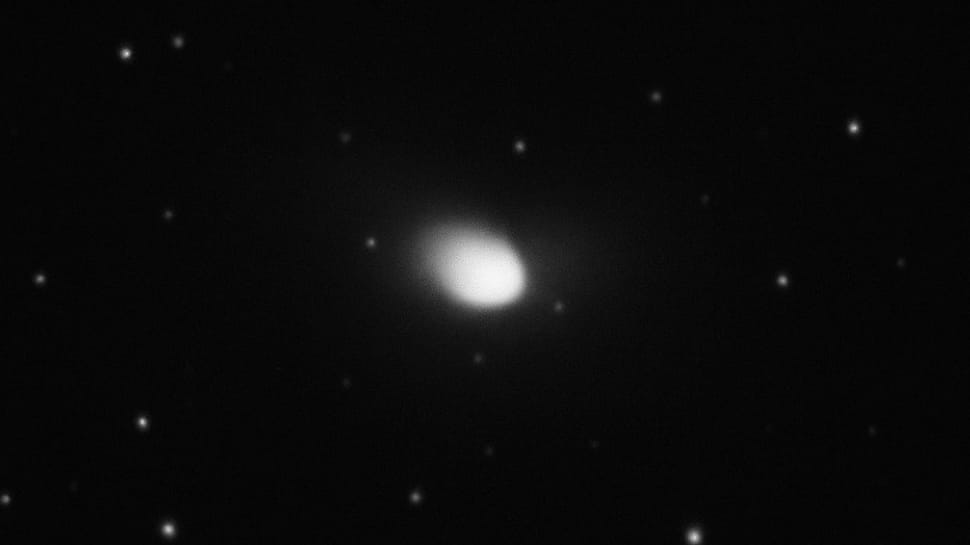
China’s Tianwen 1 orbiter has once again made cosmic history by capturing rare images of the interstellar comet 3I/ATLAS as it passed near Mars earlier this October. Released by the China National Space Administration (CNSA), the photos, taken between October 1 and October 4, provide an extraordinary glimpse into an object that originated beyond our solar system.
A Rare Encounter Beyond the Solar System
Interstellar objects like 3I/ATLAS are exceedingly rare, offering scientists only fleeting opportunities to study them before they vanish back into deep space. Prior to this, only two interstellar visitors had been confirmed, the cigar-shaped Oumuamua in 2017 and 2I/Borisov in 2019. Each of these encounters has expanded humanity’s understanding of cosmic phenomena that traverse interstellar boundaries.
Add Zee News as a Preferred Source
This time, the event prompted a global scientific effort. Both NASA and the European Space Agency (ESA) reportedly repositioned their orbiters and instruments to capture data as the comet approached Mars. CNSA’s Tianwen 1 joined the mission, turning its High-Resolution Imaging Camera (HiRIC), typically used to photograph Mars’ surface, toward the fast-moving comet.
How Tianwen 1 Captured the Elusive Comet
Tracking 3I/ATLAS was no easy feat. The comet, only about 5.6 kilometers wide, was speeding through space at nearly 129,800 mph (58 km/s), a speck of motion tens of millions of kilometers away. To lock onto it, Tianwen 1’s imaging team had to finely adjust tracking parameters and extend the orbiter’s capabilities beyond its typical Mars operations.
According to CNSA, the processed data revealed both a solid nucleus and a diffuse coma, a halo of gas and dust spanning several thousand kilometers. This observation not only demonstrated Tianwen 1’s precision but also tested its adaptability for future missions.
Why This Discovery Matters
CNSA described the imaging operation as a technical experiment, extending the orbiter’s role from Mars observation to interstellar detection. This hands-on experience will directly inform future missions, including Tianwen 2, launched in May 2025, which aims to collect samples from a near-Earth asteroid.
What does Tianwen 1 do?
Launched in 2020, Tianwen 1 made headlines when it successfully entered Mars’ orbit in February 2021. Its rover, Zhurong, became the first Chinese rover to operate on the Martian surface, exploring Utopia Planitia for about a year. While Zhurong is no longer active, the orbiter continues to function, sending valuable data back to Earth.
With these newly released images of 3I/ATLAS, Tianwen 1 adds another landmark achievement to China’s expanding space legacy. Each frame offers scientists a rare window into the mysteries of interstellar travel, proof that exploration beyond our solar system is not just science fiction, but an unfolding reality.
FAQs
1. What is 3I/ATLAS?
3I/ATLAS is an interstellar comet, an object originating from outside our solar system, making it only the third confirmed interstellar visitor after ‘Oumuamua and 2I/Borisov.
2. When did Tianwen 1 capture images of 3I/ATLAS?
China’s Tianwen 1 orbiter photographed the comet between October 1 and October 4, 2025, during its close approach to Mars.
3. Why is this discovery significant?
The event offers rare visual data on an interstellar object, helping scientists understand its structure, composition, and movement through space, insights that are nearly impossible to capture otherwise.
4. How did Tianwen 1 manage to track such a fast-moving comet?
Tianwen 1’s team adjusted its High-Resolution Imaging Camera (HiRIC) to follow the comet, which was moving at nearly 129,800 mph (58 km/s), a major technical achievement.
5. What does this mean for China’s future space missions?
The operation tested Tianwen 1’s ability to observe targets beyond Mars and provided valuable experience for Tianwen 2, China’s upcoming mission to collect asteroid samples.