
Topline
Two comets are becoming brighter in the night sky this weekend — Friday, Oct. 17 through Sunday, Oct. 19 — and could be on the cusp of naked-eye visibility. Predicted to reach their peak brightness during the new moon and the Orionid meteor shower early next week, Comet Lemmon (also called C/2025 A6) and Comet SWAN (C/2025 R2) can be found after sunset in opposite parts of the sky. The brighter Comet Lemmon — which Spaceweather.com is reporting has increased in brightness to magnitude +4.5 — will glow in the northwest, while Comet SWAN will sit low in the southwest. For the best chance to see them, look during a 30-minute window beginning about 90 minutes after sunset — and bring binoculars.
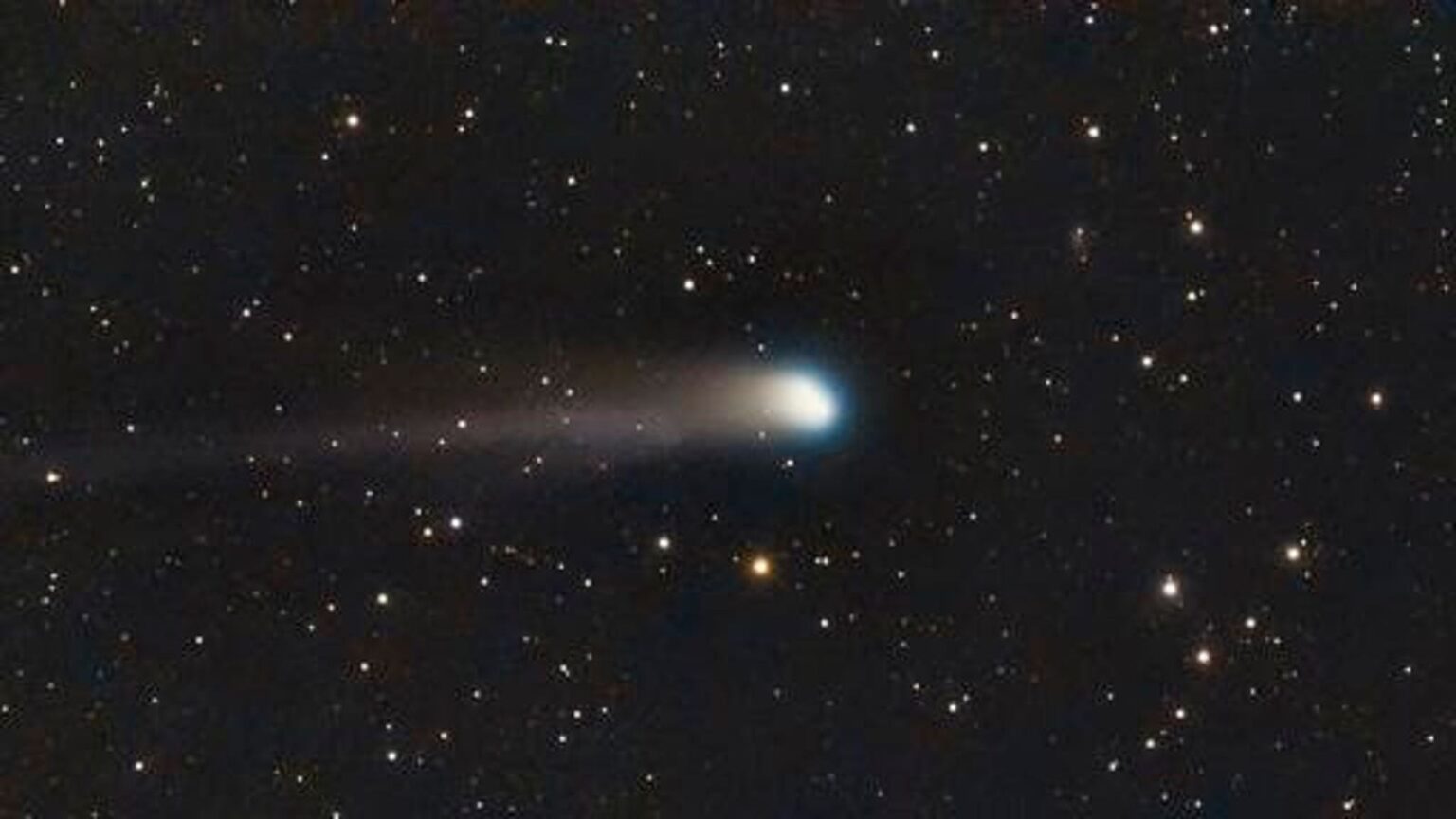
Comet Lemmon (C/2025 A6) as imaged using a Seestar S30 smart telescope from New Brunswick, Canada, by Stéphane Picard at Cliff Valley Astronomy, on Oct. 4, 2025.
Stéphane Picard, Cliff Valley Astronomy (used with permission)Key Facts
These are the first binocular comets since comet Tsuchinshan-ATLAS in Oct. 2024.
Comet Lemmon is the brighter of the two. According to the Comet Observation Database, Lemmon is shining at magnitude +4.9 and SWAN a little dimmer at +5.9 — almost bright enough to be seen from a very dark sky site with the naked eye, but binoculars will make all the difference. A pair of 8×42 or 10×50 binoculars is ideal.
Comet Lemmon was discovered on Jan. 3, 2025, by the Mount Lemmon Survey near Tucson, Arizona. It takes about 1,350 Earth-years to orbit the sun.
Comet SWAN was found much more recently, on Sept. 11, 2025, as it emerged from the sun’s glare. It takes about 22,500 years to complete a single orbit and is now moving away from the sun.
Both comets are visible to Northern Hemisphere observers this weekend — Lemmon in the northwest, SWAN in the southwest — roughly 90 minutes after sunset.
Use finder charts at In-The-Sky.com or apps like Sky Guide, Stellarium and SkySafari to find them easily.
The Nature Of Comets
Comets are unpredictable, either brightening suddenly — particularly when they get close to the sun — or dimming without warning, so it’s best to view them as soon as there’s a clear sky. “Comets love to defy expectations. While some fizzle, others become unexpected showstoppers,” said Franck Marchis, Senior Astronomer at the SETI Institute and Chief Science Officer at Unistellar, in an email. “C/2025 A6 (Lemmon) was an afterthought early in the year, but brightened dramatically this summer, likely as fresh ice was exposed. C/2025 R2 (SWAN) wasn’t even discovered until after perihelion, when solar heating triggered a surge in gas and dust. Both remind us that comets can surprise us in the best ways.”
Read More