
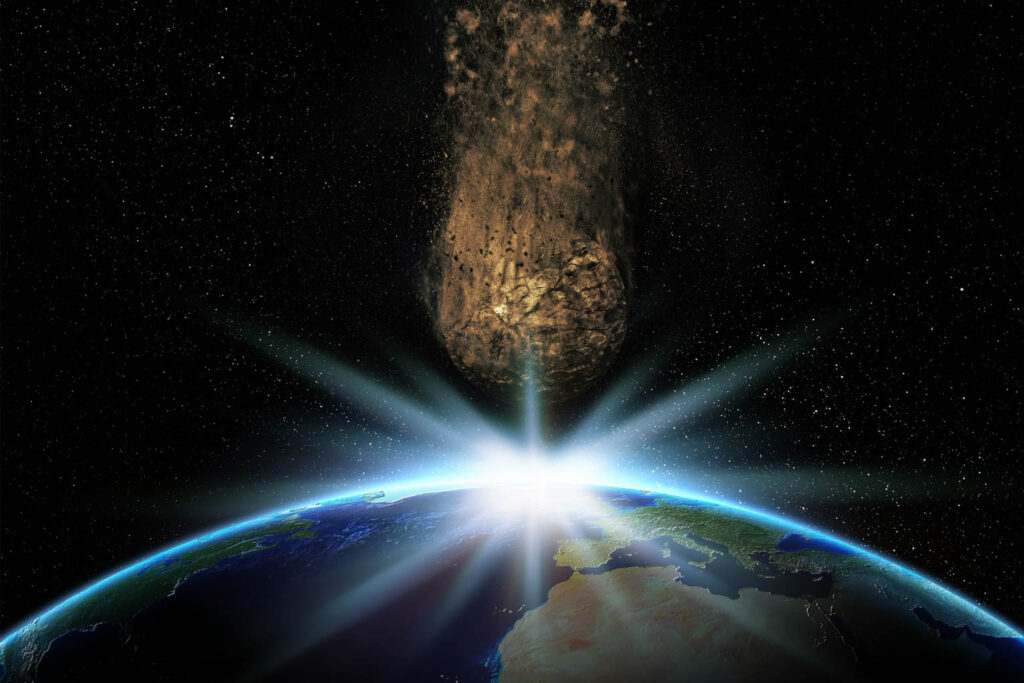
It sounds like the setup for a sci-fi blockbuster, but it’s happening right now. Astronomers in Spain have just confirmed that the comet known as 3I/ATLAS didn’t come from our cosmic neighborhood at all. It’s an interstellar traveler — a frozen messenger that has wandered through the galaxy for more than 10 million years before brushing past our Sun.
And this icy visitor isn’t just another dot in the sky. It’s a genuine time capsule, carrying clues about the origins of distant star systems and the early chapters of the Universe.
Let’s explore why this unexpected traveler has astronomers buzzing with excitement.
Origin of an Interstellar Visitor
The comet 3I/ATLAS was first spotted on July 1 from a Chilean observatory using the ATLAS (Asteroid Terrestrial-impact Last Alert System) network. At first glance, it looked like a harmless, run-of-the-mill comet passing through. But something about its motion immediately raised eyebrows.
Instead of following the curved orbit typical of comets bound by the Sun’s gravity, 3I/ATLAS traveled along a hyperbolic trajectory. In simple terms, it came from outside the solar system — and it won’t stick around for long. This makes it only the third confirmed interstellar object, after the enigmatic ‘Oumuamua and comet 2I/Borisov.
Finding one of these objects is like discovering a message in a bottle tossed across a cosmic ocean. You can study it, but only for a brief moment before it drifts away forever.
How close will it get
Before anyone imagines doomsday headlines, here’s the reassuring part: 3I/ATLAS poses no threat to Earth. Its closest approach is about 270 million kilometers, or roughly 168 million miles — far beyond any dangerous range but close enough for modern telescopes to capture valuable data.
As the comet passes silently through the outer reaches of the solar system, scientists are racing to gather information about its composition, brightness, and behavior. Every observation helps them reconstruct its long journey across the galaxy.
The silence of a distant comet might sound poetic, but to space scientists, it’s an opportunity they can’t afford to waste.
The spanish team that rewound time
Here’s where Spain takes center stage. A team of astronomers from the CITIC research center at the University of A Coruña pulled off something extraordinary: they used advanced digital simulations to trace the comet’s path back 10 million years into the past.
Using stellar data from the European Space Agency’s Gaia mission, which has produced the most detailed star map ever created, the scientists reconstructed the comet’s trajectory and pinpointed the region of the galaxy it likely came from. Gaia tracks the position, motion, and brightness of more than a billion stars. Armed with that information, the CITIC researchers ran sophisticated models to understand how 3I/ATLAS drifted into our corner of the Milky Way.
Their work shows how astronomy has changed. Understanding the cosmos isn’t just about looking through telescopes — it’s about using analytics, computation, and big data to decode what we can’t see directly.
The Spanish team’s achievement also signals something bigger: Spain isn’t just participating in global astronomy. It’s becoming a major player, contributing cutting-edge analysis that shapes how we understand interstellar objects.
Why this comet matters
So why all the excitement ? Because comets like 3I/ATLAS aren’t ordinary chunks of ice and dust. They’re ancient travelers, formed around stars that may have died long ago or that still shine hundreds of light-years away.
Their chemical makeup serves as a fingerprint of their birthplace. Studying them offers scientists an unprecedented chance to look at how other planetary systems formed. It’s like reading the genetic code of the galaxy itself.
Researchers hope to answer major questions, such as :
What raw materials were present in distant star systems ?
Did organic compounds form the same way elsewhere as they did here ?
Could the building blocks of life be scattered across the galaxy ?
Astronomer Pérez Couto from CITIC describes 3I/ATLAS as a “cosmic time capsule” — a frozen piece of the early Universe preserved for billions of years. Inside its icy layers may lie clues about chemistry, formation processes, and even the potential universality of life.
For me, this discovery brought back a childhood memory. I remember lying on a rooftop one summer night, staring at the sky through a cheap telescope my uncle gave me. I didn’t know what I was looking at, but the idea that something could drift across the galaxy for millions of years before appearing in our skies ? That would’ve blown my mind. And honestly, it still does.
What comes next
After its brief visit, 3I/ATLAS will continue its journey through deep space, likely never to return. But the impact of its passing is already significant.
The European Space Agency and other space institutions are now prioritizing the study of interstellar objects. These wandering fragments act as messengers from the early Universe, carrying patterns and materials from unimaginable distances.
Each discovery adds a new piece to the puzzle of how stars, planets, and maybe even life itself emerged. Who would’ve thought a frozen block from another system could tell us so much ?
As 3I/ATLAS keeps traveling into the dark, one thing is certain : we’re just beginning to understand the stories these cosmic visitors can tell us.
If you find this fascinating too, drop a comment, share your reaction, or tell me what you think these interstellar travelers might reveal next.