
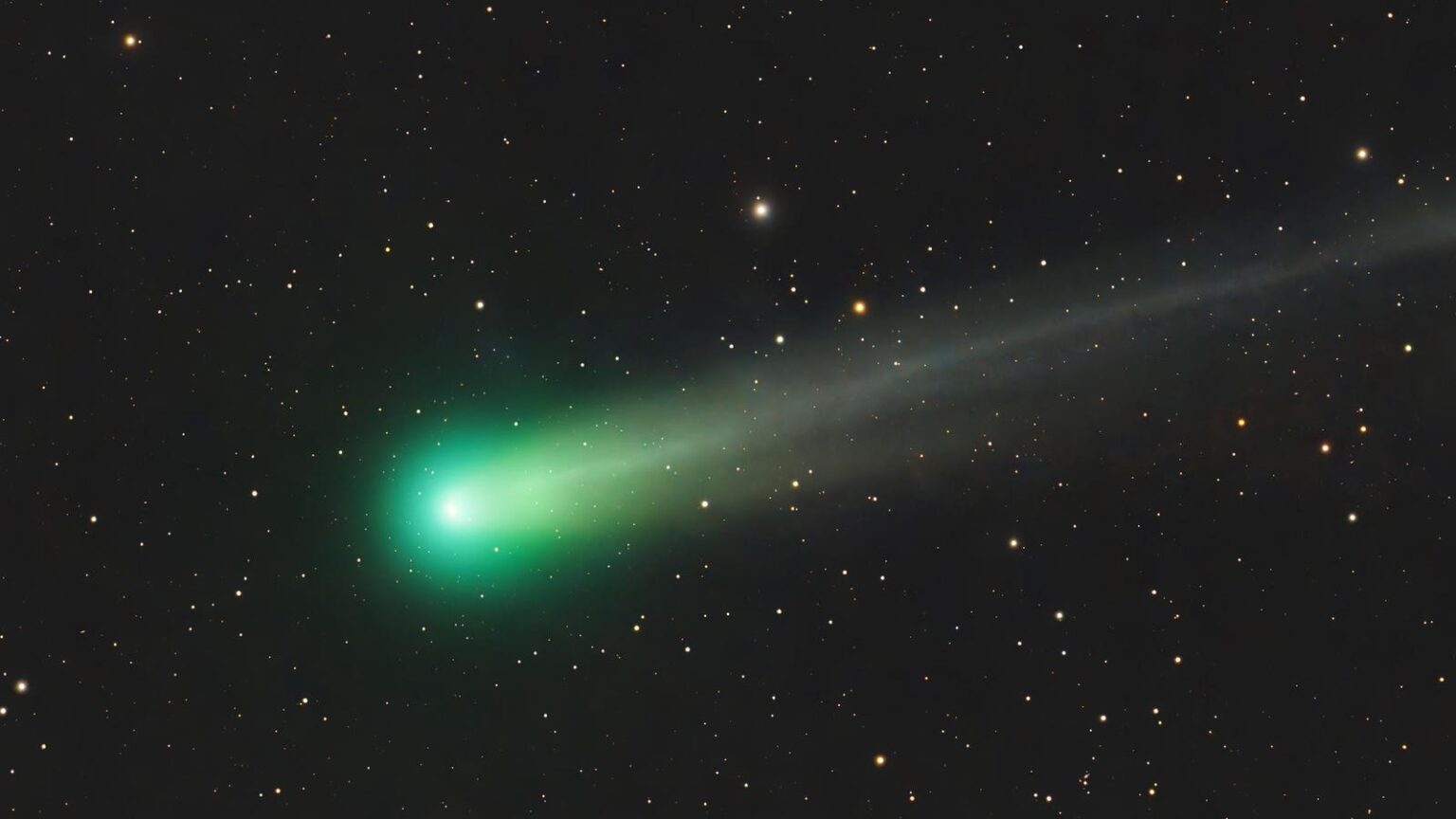
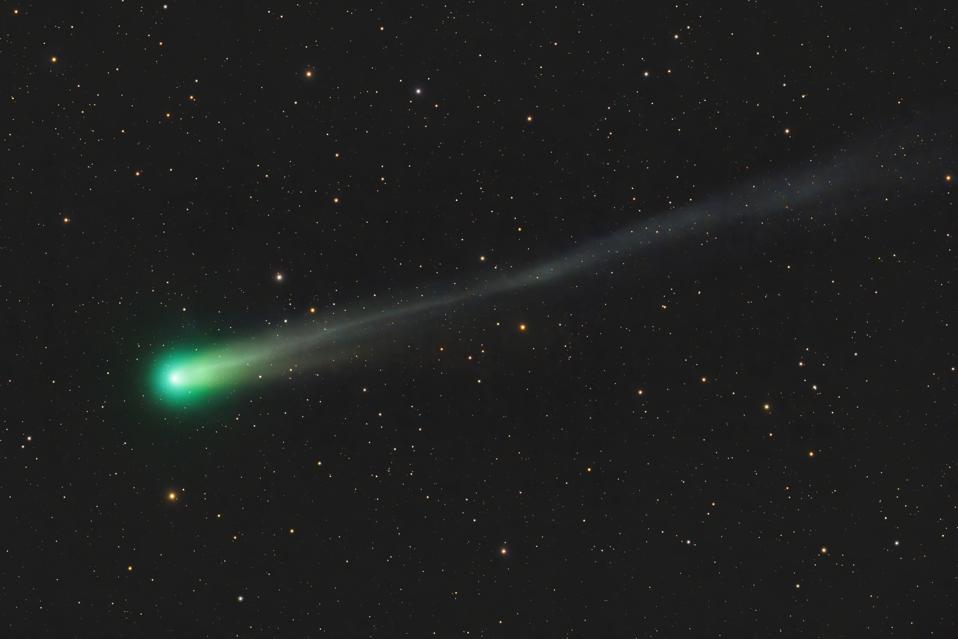
Comet C/2025 A6 (Lemmon) with a glowing green coma and visible tail navigating across millions of stars in Solar System. C/2025 A6 (Lemmon) is a non-periodic comet discovered by the Mount Lemmon Survey in images obtained on 3 January 2025.
getty
Check my feed every day this month for a daily “comet tracker” with finder charts and tips for viewing Comet Lemmon and Comet SWAN from mid-northern latitudes. Also read How To Photograph The Green Comets, Best Stargazing Apps For Finding The Comets and 25 Dark Sky Parks In The U.S. To See The Comets.
If you haven’t yet seen them, this weekend brings your final, easy opportunity to spot two glowing green comets before they fade and the brightening moon washes them from view. C/2025 A6 (Lemmon) and C/2025 R2 (SWAN) are both visible in binoculars about 90 minutes after sunset from the Northern Hemisphere — Lemmon glowing in the northwest and SWAN in the south below the Summer Triangle.
After this weekend, both comets will be too faint for casual skywatchers — and while Lemmon won’t return for over a millennium, for SWAN it’s more like 22,554 years.
How to See The Comets
Although there are some sky charts here, the best way to find the comets is to use stargazing apps such as Sky Guide, Stellarium, or SkySafari to pinpoint their positions.
Both comets appear as fuzzy, greenish patches through binoculars, with faint tails visible from dark locations. A pair of 8×42 or 10×50 binoculars is ideal. The darker your skies, the better — aim for a Dark Sky Place or anywhere far from city lights on a light pollution map. Allow 20-30 minutes for your eyes to dark-adapt.
Where to find Comet Lemmon from Oct. 23-27, 2025.
StellariumWhen And Where To See The Comets: Friday, Oct. 24
Viewing window: 7:29–7:59 p.m. EDT (sunset around 5:59 p.m.)
Here’s the best days-sky opportunity of the three, with the waxing crescent moon just 10%-lit and setting early, leaving excellent viewing conditions for comets. Lemmon will be about 59 million miles from the sun and 57 million from Earth, while SWAN will be slightly farther, at 98 million miles from the sun and 26 million from Earth.
Comet Lemmon: Trace the Big Dipper’s curved handle and go “arc to Arcturus” to the next bright star. Look above and left of Arcturus, about 20 degrees high in the northwest, near the faint star Izar. Both Arcturus and Izar are in the constellation Boötes.Comet SWAN: Look between Altair and Fomalhaut — the comet sits below Altair in Aquila/Aquarius, about 43 degrees high in the south-southwest.When And Where To See The Comets: Saturday, Oct. 25
Viewing window: 7:27–7:57 p.m. EDT (sunset around 5:57 p.m.)
This is the best-balanced evening of the three — the comets are still bright, and the moon, though slightly fatter at 16%-lit, sets early enough to preserve a dark sky for a while after sunset. Comet Lemmon will be about 59 million miles (95 million km) from the sun and 57 million miles (92 million km) from Earth, while Comet SWAN will be about 99 million miles (160 million km) from the sun and 27 million miles (43 million km) from Earth.
Comet Lemmon: Look in the northwest, now drifting into the constellation Serpens. Trace the Big Dipper’s handle, “arc to Arcturus,” and continue toward the bright star Rasalhague in Ophiuchus. Lemmon lies roughly along that line, about 20 degrees above the horizon.Comet SWAN: In the south-southwest, look below and left of Altair, between Altair and Fomalhaut. The comet hovers about 43 degrees high as twilight deepens, within the constellations Aquila and Aquarius.
Where to find Comet SWAN from Oct. 23-27, 2025.
StellariumWhen And Where To See The Comets: Sunday, Oct. 26
Viewing window: 7:26–7:56 p.m. EDT (sunset around 5:56 p.m.)
This is the final easy night to spot both comets before moonlight begins to interfere. The 24%-lit waxing crescent moon is low in the southwest, but its glow will soon start to brighten the evening sky. By now, both comets are receding from Earth and gradually fading.
Comet Lemmon: Look due west-northwest, about 21 degrees high, above and left of Arcturus, near the faint star Izar. You can use Vega, high overhead, as a guide — Lemmon sits nearly straight below it.Comet SWAN: Still found between Altair and Fomalhaut in Aquarius, the comet sits about 45 degrees high in the south after sunset. Look for a faint, diffuse glow through binoculars before the moon brightens later in the evening.When The Comets Will Return
Comet Lemmon was discovered on Jan. 3, 2025, by the Mount Lemmon Survey in Arizona and will reach its closest point to the sun (perihelion) on Nov. 8. It last visited the inner solar system about 1,350 years ago and won’t return until around 1,150 years from now. The reason for the shorter journey next time is Jupiter, whose gravity distorted Lemmon’s orbit when it passed close to it during April.
Comet SWAN was found on Sept. 11, 2025, by the Solar and Heliospheric Observatory’s SWAN instrument, as it emerged from the sun’s glare. A faster-moving, long-period comet, it travels on a 22,554-year orbit around the sun, so we’re witnessing something very rare.
This is a Hubble Space telescope image of the interstellar comet 3I/ATLAS. Hubble photographed the comet on 21 July 21 2025, when the comet was 445 million kilometres from Earth.
NASA, ESA, D. Jewitt (UCLA), J. DePasquale (STScI)3I/ATLAS: The Interstellar Comet
Hidden in the sun’s glare this month is Comet 3I/ATLAS, the third interstellar object ever discovered and the first bright enough for detailed study. Unlike Lemmon and SWAN, which originate from the Oort Cloud surrounding our solar system, 3I/ATLAS hails from another star system entirely. It’s racing through our solar neighborhood at 67,000 mph (108,000 km/h) — a true cosmic visitor, here only once. It’s faint — around magnitude +11 — but visible through large telescopes, offering astronomers a unique chance to compare an alien comet with local ones in the same season.
Wishing you clear skies and wide eyes.