
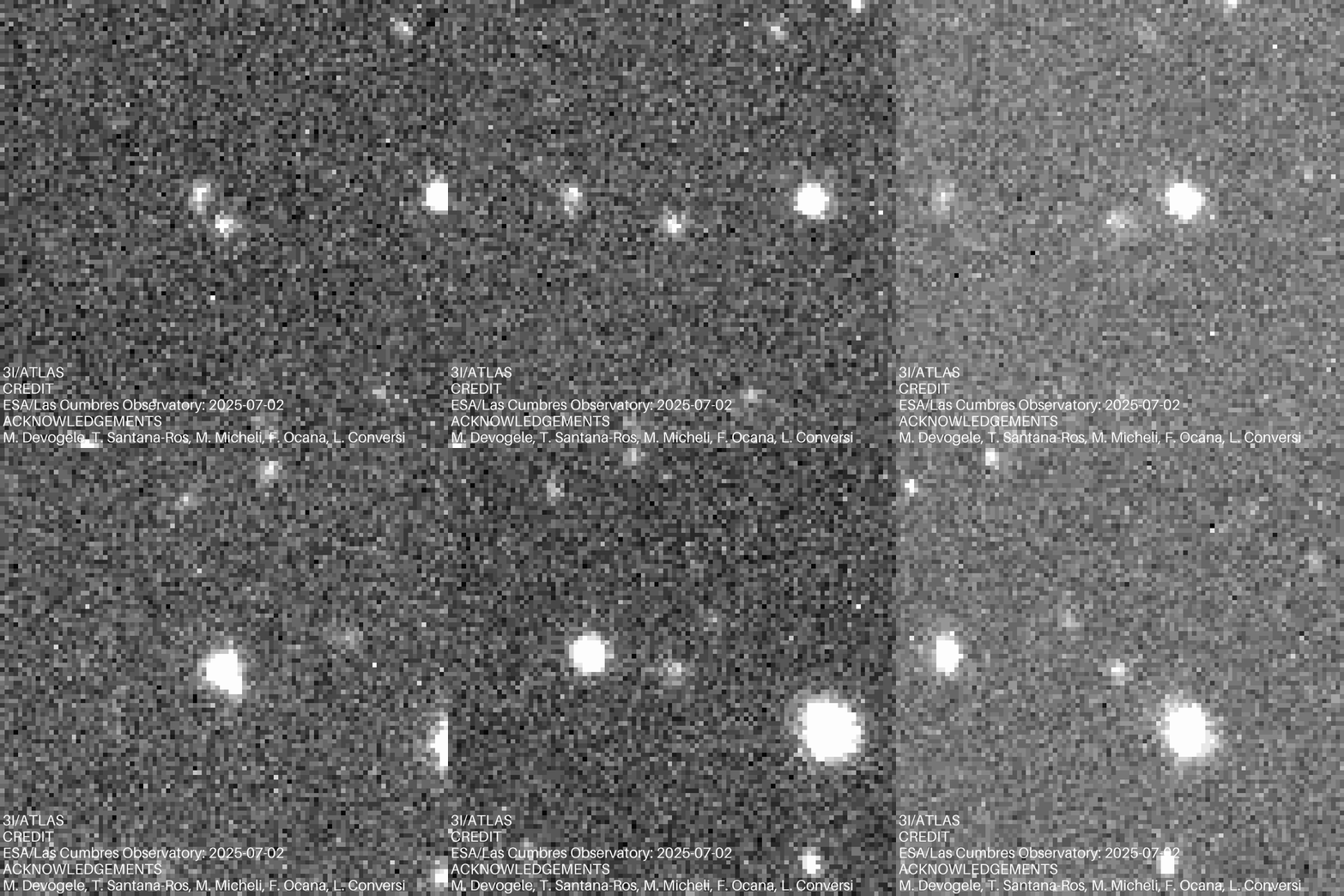
What is comet 3I/ATLAS?
Comet 3I/ATLAS is a newly identified interstellar object, meaning that it comes from outside our Solar System. It is only the third of its kind ever observed, following 1I/ʻOumuamua in 2017 and 2I/Borisov in 2019.
Why is it important?
These comets are absolutely foreign. Every planet, moon, asteroid, comet and lifeform in our Solar System share a common origin. But interstellar comets are true outsiders, carrying clues about the formation of worlds far beyond our own.
When and how was it detected?
It was first spotted on 1 July 2025 by the Asteroid Terrestrial-impact Last Alert System (ATLAS) telescope in Río Hurtado, Chile. Its unusual trajectory immediately raised suspicions that it originated from interstellar space. This was later confirmed by astronomers around the world, and the object was given its formal designation: 3I/ATLAS.
Why the name ‘3I/ATLAS’?
Traditionally, comets were named after the person who discovered them. Nowadays, we follow a coded naming system developed by the International Astronomical Union. The first letter indicates the category that the comet falls under – in this case ‘I’ for ‘Interstellar’. The number ‘3’ before the ‘I’ indicates that the comet is the third of its kind. The word ‘ATLAS’ refers to the programme that operates the telescope that first spotted the comet.
Find out more about how comets are named here.
Can you give some quick facts about the comet?
Size: a few hundred metres to a few kilometres across
Speed: roughly 210 000 km/h – the highest ever recorded for a Solar System visitor
Age: billions of years old – indicated by its breathtaking speed, evidence that it has been drifting through space for a very long time
Closest approach to Earth: about 270 million km (19 December 2025)
Closest approach to Mars: 30 million km (3 October 2025)
Closest approach to the Sun: 210 million km (30 October 2025)
Does it pose a danger to Earth?
The closest the comet will come to Earth is about 270 million km – that’s about 1.8 times the distance between Earth and the Sun. During its closest approach to the Earth, it will be on the other side of the Sun. It poses no danger to our planet or any other planets in the Solar System.
Is ESA’s Planetary Defence Office tracking the comet?
Yes. ESA’s Planetary Defence Office responded promptly to the discovery, with ESA astronomers contributing to global efforts to track the comet’s path using telescopes in Hawaii, Chile and Australia. They are also looking for evidence of its existence in older data – a process known as ‘precovery’.
These efforts are part of ESA’s broader mission to detect, track, and characterise near-Earth objects – though 3I/ATLAS is not considered one, due to its distance from our planet.
By the time the comet reaches its closest point to Earth, it will be hidden behind the Sun. It is due to reappear in late November, offering astronomers another window for study.
What will happen to 3I/ATLAS in the coming months?
3I/ATLAS is an active comet. Observations by the NASA/ESA Hubble Space Telescope already captured a dust plume ejected from the Sun-warmed side of the comet, and the hint of a dust tail streaming away from its nucleus. Comets originating within our own Solar System display similar behaviour.
As the comet continues to approach the Sun, it will likely lose more and more mass as frozen gases transform into vapour, carrying dust and ice into space. Observations by the NASA/ESA/CSA James Webb Space Telescope of the coma, or ‘halo’, surrounding the comet already reveal carbon dioxide, water, carbon monoxide, carbonyl sulphide and water ice being released as the comet heats up.
Find out more about the structure of a comet here.
Is ESA planning to visit 3I/ATLAS?
The comet will make its closest approach to the Sun on 30 October 2025, passing just inside the orbit of Mars. After that moment, it will speed away from the centre of the Solar System. This is far too soon, and the comet is moving far too quickly, to contemplate sending a spacecraft to visit or land on it. Instead, we are observing 3I/ATLAS from a distance with our space telescopes and planetary missions.
What ESA missions will observe 3I/ATLAS?
In the first months after its discovery, the comet was observed by space telescopes close to Earth, including the NASA/ESA Hubble Space Telescope and the NASA/ESA/CSA James Webb Space Telescope. This autumn, ESA is turning interplanetary voyagers such as Mars Express, ExoMars Trace Gas Orbiter and the Jupiter Icy Moons Explorer (Juice) in the direction of the comet to make further observations with eyes from all over the Solar System. 3I/ATLAS will pass through the field of view of the ESA/NASA Solar and Heliospheric Observatory (SOHO), but we expect it to be much too faint to be visible.
When and how are ESA’s Mars’s missions observing 3I/ATLAS?
ESA’s Mars Express and ExoMars Trace Gas Orbiter (TGO) observed the comet with several instruments around its closest approach to Mars on 3 October 2025. On that date, 3I/ATLAS was around 30 million km from Mars.
Read more about their observations here.
When and how will ESA’s Juice mission observe 3I/ATLAS?
Of all ESA interplanetary spacecraft, the Jupiter Icy Moons Explorer (Juice) is likely to have the best view of 3I/ATLAS in a very active state. Juice will attempt observations in November 2025 using several instruments, including cameras, spectrometers and a particle sensor. Coordination with NASA’s Europa Clipper mission is being considered, in particular to observe using the twin ultraviolet spectrographs (one on each spacecraft).
As Juice is currently close to the Sun, it is using its main high-gain antenna as a heat shield. It is using its smaller medium-gain antenna to send data back to Earth at a much lower rate. It is also far from Earth, on the other side of the Sun. Therefore, we don’t expect to receive data from Juice’s observations of 3I/ATLAS until February 2026.
Is ESA planning any missions to visit a comet in the future?
Following in the footsteps of ESA’s Rosetta mission, which landed on Comet 67P in 2014, ESA is currently developing the next-generation comet mission, Comet Interceptor. Comet Interceptor will be the first mission to visit a comet coming directly from the outer reaches of the Sun’s realm, carrying material untouched since the dawn of the Solar System. It is also possible – though very unlikely given their rarity – that Comet Interceptor could visit an interstellar comet.
Find out more about Comet Interceptor here.