
![[OC] The Habitable Zone: A Diagram of all the Potentially Habitable Exoplanets](https://www.ufofeed.com/wp-content/uploads/2025/08/ew2VoG6maG9L8YdvJMspyWJzHfsYhdtXRd9rbq2_0RA-1536x1086.jpeg "[OC] The Habitable Zone: A Diagram of all the Potentially Habitable Exoplanets")
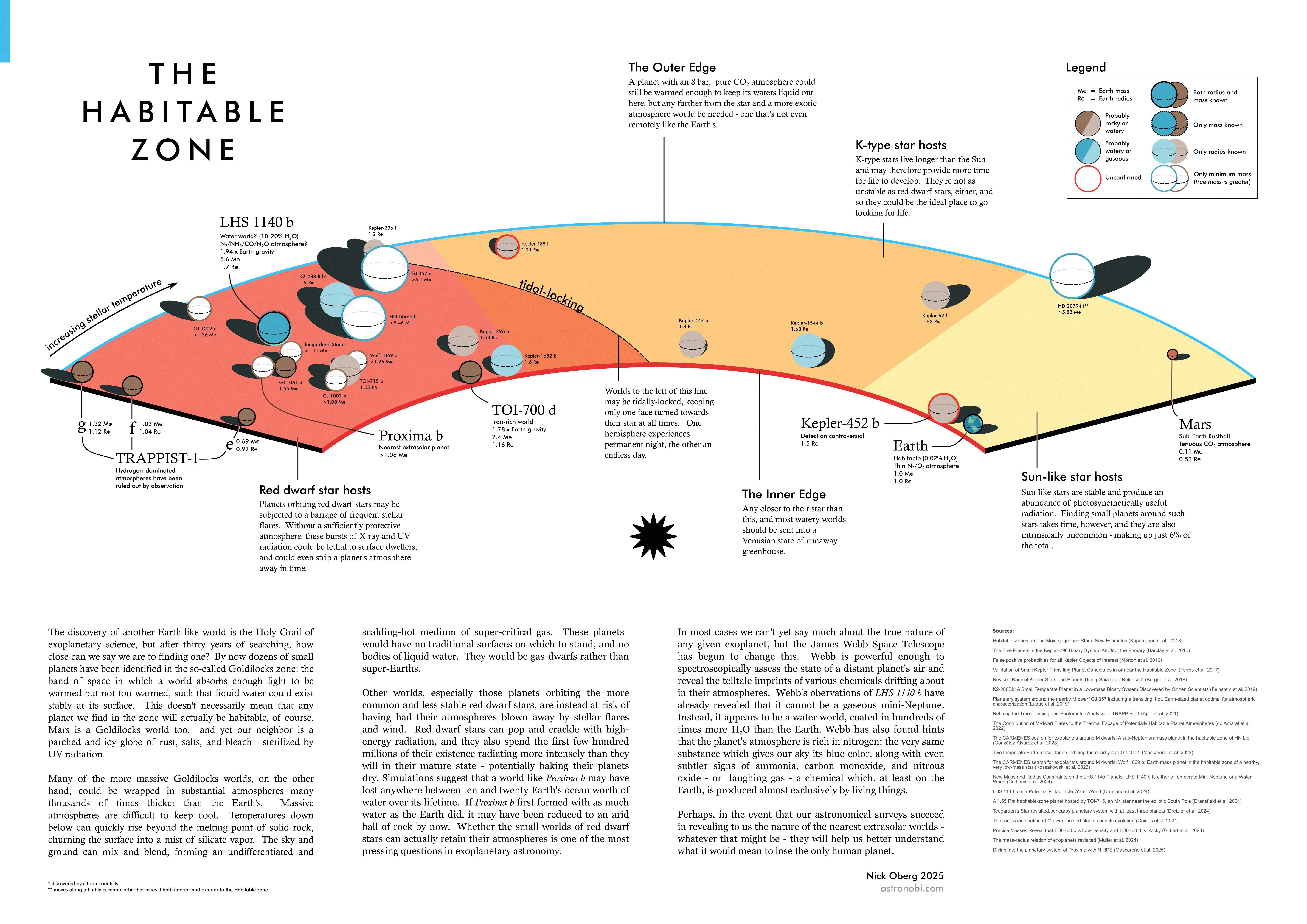
As of July 2025, more than twenty worlds potentially capable of hosting liquid water have been identified in the conservative 'Habitable Zone' of their respective stars. This diagram presents those which are most likely to be rocky or watery, rather than gaseous, by including only those with a radius less than 2 Earth radii or a (probable) mass below 10 Earth masses.
Only one of these worlds, LHS 1140 b, has had the composition of its atmosphere measured so far. The nature of nearly all the other Goldilocks planets remains almost totally mysterious, although the worlds of TRAPPIST-1 are suspected to have lost their atmospheres to stellar flares and wind.
by astronobi
3 Comments
I know that reddit mobile can mess with large images, so here is a direct link:
[http://astronobi.com/infographics/habitable_zone.jpg](http://astronobi.com/infographics/habitable_zone.jpg)
Tools used to produce the visualization:
Python/matplotlib to sort, clean, and display the data ( [https://exoplanetarchive.ipac.caltech.edu/](https://exoplanetarchive.ipac.caltech.edu/) )
Blender as a reference for the shadows
Inkscape to create the final product and format the text
Academic sources are listed in the diagram.
Notes:
This visualization represents only the ‘conservative’ habitable zone as defined by Koparrappu et al. 2013, which is more strictly defined than the ‘optimistic’ habitable zone, and does not take into account the hypothetical ‘Hycean habitable zone’ or icy worlds with subsurface oceans.
Wouldn’t our presence/ exploration of these potential worlds cause massive biological fallout through the introduction of microbes/ bacteria?
Or would those organisms be inert since they didn’t evolve to thrive in that specific environment
I’m always wondering if life could be possible on tidally locked planets, and what that would look like.